
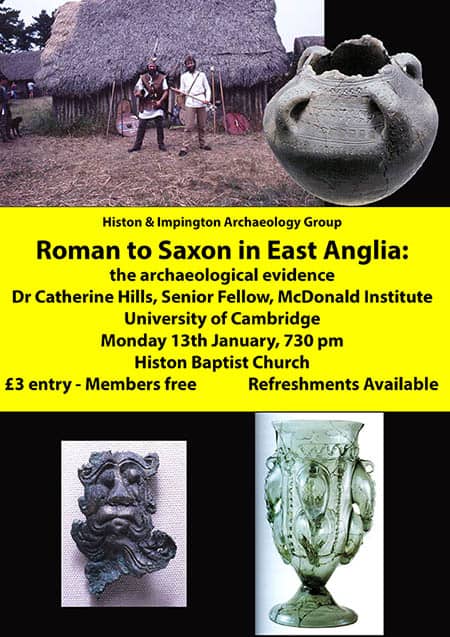
Roman to Saxon in East Anglia: the Archaeological Evidence
Histon & Impington Archaeology Group – the January Talk
Roman to Saxon in East Anglia: the Archaeological Evidence with Dr Catherine Hills (Senior Fellow, McDonald Institute for Archaeological Research, University of Cambridge) on Monday 13th January 2020, 7.30 pm at Histon Baptist Church
After 350 years within the Roman empire the 5th century saw great changes in Britain. The traditional story is that Anglo-Saxons were first invited in as mercenaries and given land in return. After some setbacks, they gradually came to militarily and culturally dominate England, while British Celtic speaking peoples were pushed out to the west. This account was based on documents written long after the event. It is no longer supported by archaeological and other evidence – which points to a more complex and regionally varied story of interaction between incomers and natives. The fifth to sixth centuries was a critically important time in our history – the start of the evolution from Roman Britain to the medieval kingdoms of England, Scotland and Wales.

Dr Catherine Hills is a leading expert in Anglo-Saxon material culture. She is a Senior Research Fellow at the McDonald Institute for Archaeological Research, at the University of Cambridge. She directed the excavation of the famous early Anglo-Saxon cremation cemetery at Spong Hill, North Elmham, Norfolk. Her work has made substantial contributions in the fields of early Anglo-Saxon archaeology, particularly regarding burial and migration, and more recently the chronology of the 5th century. In the 1980s she presented the two Channel 4 series The Blood of the British and Down to Earth.
The poster shows some items of transformation from Roman to Anglo-Saxon- a foot of a funerary cruciform brooch found at Spong Hill , a glass vessel from Mucking which has evolved from a Roman form – and an unusual Saxon pot from Spong hill , with handles and stamped decoration.