From fallen trees to flooding, knowing who to call when things go wrong in the village is the first step to getting them put right. Denis Payne lists the most common incidents – and what to do about them.
Knowing who has the authority to sort out problems that arise in public places is a useful starting point for resolving them, but with four levels of ‘local’ government and several other bodies involved, it’s difficult working out who does what and who to speak to if things need fixing.
Local government
Advert
Some of the issues are dealt with by ‘local’ government and other bodies paid for from our Council Tax, so here are some clues:
The Parish Council – closest to us, 19 Councillors elected from Histon and Impington, and with offices in the village. They have few duties (i.e. things they have to do), but for us, among other things they provide the civic cemetery, recreation and play areas, and look after various areas of the village, including the Green. They’re our voice to higher authorities – particularly on planning.
The District Council – based at Cambourne, with 3 Councillors for us to vote in. They collect refuse, manage most of the planning decisions, provide and manage housing, are responsible for the key drains, and other environmental issues (noise, pollution).
The County Council – now based at Alconbury, with just one Councillor representing the village, Orchard Park and King’s Meadows. They provide essential social services for vulnerable adults and children. Schools and education (but not academies), maintain highways (but not the A14, M11) and dispose of waste (collected by the District Council).
The Combined Authority are based in Huntingdon, and the Mayor is elected by everyone in Cambridgeshire and Peterborough. Other members of the Board are appointed by Unitary (Peterborough), County and District (& City) Councils. They have funding from the Government, and our Council Tax. They support public transport, and are responsible for top level transport planning. They support and deliver a range of projects focusing on economic growth and helping to improve lives.
Other key players
Also funded by Council Tax are some emergency services:
Cambridgeshire Constabulary – there’s a single elected Police and Crime Commissioner for Cambridgeshire & Peterborough. On more day-to-day issues there’s a Chief, Deputy Chief and Assistant Chief Constable.
Cambridgeshire Fire & Rescue – is run by a Board of 17 Councillors appointed by the County Council and Peterborough City Council.
And finally:
Greater Cambridge Partnership – has members appointed by City, District and County Councils and also business and university representatives. It’s funding comes from Government grants. Most times it is unable to act without the support of one or more of the Councils – who are therefore the final decision maker.
Dealing with a problem
As always, if it is an emergency, as someone is hurt or lives may be at risk, call 999. Most Councils only work office hours (and not weekends) so outside those hours you’ll only be able to report something – and it will take time to fix.
Several problems could require police action but aren’t life threatening. In that case 101 is the number, but in Cambridgeshire you can jump the inevitable phone queue by using their new online reporting system at www.cambs.police.uk/ro/report/. Just click ‘Report’ on the left hand side of the home screen. Reports are dealt with in exactly the same way as 101 calls.
What to do if…
Here are some of the most common incidents that arise in the village – and what to do about them.
Anti-social behaviour – is always a Police issue, so call 101 (or 999 in an emergency) or www.cambs.police.uk/ro/report/. Even if you think nothing will happen, do report it. The total amount of ASB influences policing patterns.
Broken glass in play areas – the Parish Council has a ranger who will clear this (during work hours). Call 01223 235906.
Fallen tree – if it’s blocking a road, it’s a highways emergency so call the County Council on 0345 045 5212 during office hours, or Police on 101 or www.cambs.police.uk/ro/report/ outside of those hours. Otherwise, it will be the owner who will need to deal with it. The Parish Council may be able to help find out who that is, so call them on 01223 235906.
Flooding (roads) – it’s a highways emergency if the road is impassable so call the County Council on 0345 045 5212 during office hours, or Police 101 or www.cambs.police.uk/ro/report/ outside of those hours.
Overflowing bin – on the High Street, report to a nearby shop. Elsewhere, report to the Parish Council on 01223 233577. Because these are cleared by the District Council it may take a while to get sorted.
Traffic lights – if all the lights are out, that’s an emergency so call the County Council on 0345 045 5212 during office hours, or Police 101 or www.cambs.police.uk/ro/report/ outside of those hours.
Water leak (road or path) – Cambridge Water supplies water to the village, so call 0800 316 76 76.
With a third of all vehicles failing their annual MOT, it’s easy to see why proposals to change the rules are proving controversial. Buckingham & Stanley’s MD, Andrew Ballard, talked to Lucy Callington about the future of the annual MOT test and the changing face of motoring.
Since the MOT test was first devised back in 1960, the landscape of driving has changed dramatically but the test itself has not. That’s why the Government has launched a consultation seeking views on the future of driving generally, and the annual safety test in particular.
Headline proposals from the consultation include changing the requirement for the first MOT for new vehicles from three to four years, and every two years after that.
Advert
Buckingham and Stanley has been offering MOTs at its Histon site for over 50 years. I asked Managing Director Andrew Ballard how important to road safety and the longevity of a vehicle MOTs really are. “The test is fundamental to the safety of vehicles and to road safety in general” he said. “We find that nearly a third of cars fail their MOT with us, which mirrors the picture nationally.
“The most common faults are lighting, tyres, brakes and suspension components – all vital safety concerns. While some people regularly maintain their vehicles to a safe standard, others rely on the MOT test to flag up any faults.”
The Department of Transport is consulting on the first changes to the MOT testing system for decades. Photo: Lucy Callington
Does Andrew agree with the Department of Transport’s statement that the change from three to four years for the first MOT – standard practice across many European countries already – won’t impact road safety? “Many motoring organisations are strongly opposed to this and it’s easy to see why” he said. “10% of cars fail the first MOT at three years so it seems logical that the number of failures would increase in an extra year without testing.
“At the moment, when potholes are so prevalent, damage to tyres and suspension components can easily go unnoticed by the driver. The MOT test can, and often does, highlight these issues before a failure occurs.”
Counting the cost of checks
Despite the Government’s statement suggesting that the move to four years before first testing would save motorists around £100 million a year in MOT fees, critics of the proposed change argue that it could lead to increased vehicle repair, maintenance and insurance costs.
So does Andrew think the figures really stack up?
“It’s clear that there would be a reduction in the number of MOT tests carried out, but the industry is already going through a shortage of testers, so this may perhaps mitigate that situation.
“What could change is the number of stations giving discounts for MOTs. Fewer stations and testers will likely see the average cost of the MOT rise. The cost of our MOT at £54.85 has not changed for over ten years, despite labour costs and overheads rising dramatically.”
Evolving with Electric
Among the proposals, the consultation will consider whether electric vehicles’ (EV) batteries should be tested to improve their safety and reliability. I asked whether Andrew feels the current MOT system for EVs is fit for purpose.
“In the future, the complexity of vehicles will mean a change of testing standards, but this has always happened organically over the years anyway. Imagine the vehicles that were tested in 1960 when the MOT was first introduced. They are certainly very different from the cars and motorbikes we own now. Over the next few years, the focus is likely to change to testing the safety systems on EVs, such as blind spot and Advanced Driver Assistance Systems (ADAS).”
Buckingham & Stanley Histon has been offering MOT testing for over 50 years. Photo: Lucy Callington
Putting Safety First
The Government’s consultation is a chance for all parties concerned with road safety to have their say, and Andrew is pleased that this will open up conversations between drivers, garages, motoring organisations and the Government.
“Due to continued development and testing we have some of the safest roads in the world and I don’t think any steps to jeopardise that would be allowed to happen.”
It’s a view echoed by Edmund King, president of the AA, who states: “The MOT plays a vital role in ensuring that vehicles on our roads are safe and well maintained. We strongly discourage the Government from extending a car’s first MOT to the fourth anniversary due to road safety concerns.”
Whatever the future holds for MOTs, the Government is quick to remind the public on its consultation documents that keeping their two- and four-wheelers safe and legal is ultimately the responsibility of road users.
The deadline for the public to have their say on proposals is 11:45pm on 22 March 2023. Visit the consultation web page to have your say on the future of MOTs.
This weekend sees the start of a month long exhibition at Ely Cathedral for local artist Stephen Tromans. Amanda Borrill met up with him to discover more about the inspiration behind these unique works of art.
Tucked away in a quiet corner of Impington’s The Crescent you’ll find the studio of local artist Stephen Tromans. A barrister and King’s Counsel by profession, specialising in environmental and energy law, Stephen took up painting as a hobby around ten years ago and his work features regularly in the popular Open Studios events.
Trafalgar Square. One of Stephen’s very early works produced in 2014.
Climbing the stairs of his studio annex, it is clear to see this ‘hobby’ is an immensely productive one. In the hallway of the home he shares with his wife Caroline, art sits on floors leaning up against the walls and the studio itself displays an abundance of work from across the years, including an eye catching ‘Trafalgar Square’ with stunning black frame that wouldn’t look out of place in the National Gallery. This is one of Stephen’s very early works created in 2014, quite soon after he took up painting in oils and, he tells me, loosely based on a similar painting by the Norfolk painter Edward Seago.
Advert
His wife Caroline, he confesses, is to be thanked for, “putting up with all the clutter, distraction and absent mindedness that seems to go with producing art” and as the wife of a ‘tech guy’, I can’t help thinking it’s infinitely preferable to the PC World feel that often dominates my own hallway.
A lifelong passion
A lifelong lover of art, like so many of his generation he was steered away from the subject in school – being viewed only as a rather frivolous way to spend your time – and encouraged to pursue what were considered ‘more productive’ academic avenues. A law degree followed with Stephen spending some time teaching law at Cambridge University. But the desire to paint never really diminished and in 2013 he took himself off on a beginner’s course at Norfolk Painting School, completing a Diploma in oil painting in 2018.
Grenfell Tower recreated in art from photos.
I was struck by the contrast between legal career and artist but Stephen was quick to point out that life as a barrister is nowhere near as exciting as it might appear on TV. Both activities involve long periods of solitude – in his legal world that time is spent working with words but in his artistic life it’s taken up creating images.
There are, however, occasional crossovers and it was through his legal firm’s involvement with the Grenfell Tower inquiry that Stephen created his painting of the Tower (pictured left). Recalling how it came about he told me: “A number of barristers in my Chambers were involved in the inquiry and when it came to an end I was asked if I would create a painting of the Tower as it was before the fire. It proved quite difficult to get a suitable image of the Tower before the fire and I wanted to give the building some nobility as a mark of respect for those who lived, and died, there”.
Making an impact
Stephen’s exhibition, which opens this coming Saturday, 18 February, is set to make quite an impact in Ely Cathedral’s Lady Chapel. Entitled GOLGOTHA 2022 Russia’s Invasion of Ukraine and Christ’s Passion, the work, which began almost immediately after the invasion began in 2022, sets the events in Ukraine against the Easter story which was unfolding at the same time. Taking his influence from some of the great artists of the past such as Goya, Picasso, Rubens, and Rembrandt – all of whom have themselves sought to depict both the horrors of war and the suffering of Christ – one year on Stephen is seeking to draw out the meaning of Christ’s Passion and what it has to say now in speaking of human suffering and human evil.
Stephen’s ‘Alien World’. One of a series of four images. Oil over collage on board. Photo: Amanda Borrill.
Stephen tells more: “On 24th February 2022 Russia invaded Ukraine. This profoundly shocking action was to give rise over the ensuing months to untold human misery in loss of life, injury, rapes and other war crimes, the separation of families, mental and physical trauma and loss of homes and possessions. It was the cause of the worst refugee crisis in Europe since World War II.
“In the period before Lent 2022 I had been working on a religious triptych, ‘Transfiguration, Crucifixion and Resurrection’, which was exhibited in my local parish church, St Andrew’s Impington. Oddly, much of the tone and colour of these works prefigured the images of war from Ukraine. The work then came in two main phases: an initial burst of activity over the Spring and early Summer, which resulted in a number of images which I was able to display at my Open Studios in 2022 with visitors including a number of Ukrainians who had been offered homes by people here in our community.
“There was then a second burst of activity in the period after November 2022 by which time I had the opportunity to have read and reflected further on events”.
A labour of love
Stephen has really had his work cut out for this upcoming exhibition. He was offered space for 25 pieces and, at Christmas last year, had completed just 11! So things have really moved on these last few months. “I suffered a detached retina last year” Stephen reveals “and much of the work I have produced was done using only my remaining working eye. Things are gradually easing but, yes, it has certainly presented me with a few challenges along the way.”
Thanking those involved in getting this off the ground, Stephen shared: “I am most grateful to the Dean and Chapter of Ely Cathedral for permission for this exhibition in the calm and beautiful setting of the Lady Chapel, and to Jocelyn Palmer and Caroline Harrison of the Events Team at the Cathedral for facilitating it. I am also grateful to my friend Peter Garside, a guide at the Cathedral, for the initial suggestion of an exhibition there”.
Much support from our local businesses here in Histon & Impington has gone into the exhibition too, with the photography of many of the paintings for the catalogue undertaken by Stuart Norris of Outdoor Imaging Impington and the brochure itself produced by Histon’s Print-Out.
Praying for peace
It is hoped that the exhibition will boost Stephen’s fundraising for the Ukraine Humanitarian Fund. Already, in 2022, Stephen has raised £6000 from the sale of his artwork and this event will give further opportunity to support the appeal with 75% of the money raised through sales of his work going directly to the Humanitarian Fund and the remaining 25% to Ely Cathedral.
I asked Stephen what visitors to the Lady Chapel can expect when they visit and his message was this: “Those visiting the beautiful and calm surroundings of the Lady Chapel at Ely will find over two dozen paintings exploring these themes. Whether or not you have Christian faith, I hope that you will find here food for reflection as we again approach Easter, and that you will be prompted to pray for the people of Ukraine, and for peace in that country and in our world.”
Val Robson has been out and about in Histon & Impington exploring the many different ways we can recycle and rehome our unwanted items.
It’s that time of year again when we begin to contemplate a spot of spring cleaning and decluttering, in the hope of recycling or rehoming those things we no longer want or need. We’ve all become familiar with the regime of recycling into our blue or green wheelie bins but what about those ‘grey area’ items that nobody knows where to put? Haven’t we all had those ‘can we put crisp packets in the blue bin?’ type conversations?
South Cambs District Council has a handy ‘what goes in what bin’ web page but where do we put that stuff we don’t want to end up in landfill, but is barred from our blue and green bins?
Advert
Pringles Tube recycling at the Scout Hut near to IVC Sports Centre Photo: Val Robson
Pringles tubes
Pringles tubes are a real challenge for recycling plants. While the plastic lid can be recycled in our blue bins, the tubes have layers of plastic, foil and card which cannot be separated except at a specialist plant. There is good news to share though and the very many of us who ‘pop but can’t stop’ will be relieved to hear that 1st Histon Scouts have come to the rescue with the purchase of a bright red wheelie bin located outside their Scout Hut. The club will be monitoring the bin themselves with the discarded tubes being transported to a specialist paper recycling mill in Stainland, Halifax for full recycling. Talking to HI HUB, Group Scout Leader, Richard Martin, said, “one of our Group Executive members has agreed to keep on top of it. However, its apparent popularity has caught us a bit by surprise!”.
Lara Kingsman with a bag of blister packs for Superdrug Photo: Lara Kingsman
Blister packets
Another ‘no no’ for our bins are those blister packets many pills come in. The mixture of plastic and foil means they can’t go in the blue bin but, fear not, help is at hand in the form of Lara Kingsman, local resident and recycling hero. Every few months, via local community Facebook groups, Lara invites villagers to drop their empty blister packets off with her for recycling. All Superdrug stores with pharmacies will recycle these items and Lara regularly takes sacks of them into the nearby Cambridge branch. She took a record eight bin-liners full in January! The next collection will be in early March so keep an eye on local social media for details or, alternatively, email Lara on lara.kingsman@gmail.com for more information.
Soft Plastics Recycling at the Coop Photo: Val Robson
Soft Plastics including crisp bags and pet food pouches
Possibly the busiest recycling point in the village can be found just inside the doors of our local Histon Co-op where there is a recycling bin for all soft plastics – this includes crisp packets, sweet wrappers, plastic film, pet food pouches and plastic bags. Launched in July 2021 as part of the Coop’s nationwide recycling scheme Pam Wilderspin, Team Leader at the store, told HI HUB: “The scheme is very popular and we empty the bin three times a day. Weekends are the busiest and then we sometimes empty it more than that. Some customers have come in and asked for the yellow plastic bags that the items go into so they keep it at home and bring it in once full. We are happy to provide the bags for that purpose”.
Shoe Bank at Histon Post Office Photo: Val Robson
Shoe Bank
Step across the road and located right outside Histon Post Office you’ll find a Shoe Bank – sole destination for recycling those unwanted shoes. The shoes are collected every two weeks on behalf of Variety, the Children’s Charity and sorted into categories. Worn-out shoes are used to manufacture materials like insulation for buildings. Others are distributed to developing countries around the world where they are refurbished by local people, thus creating much-needed employment. Harry Parekh, former sub postmaster who still helps out at the Post Office, revealed, “it is very well used and sometimes we have to call to have the Shoe Bank emptied more often as there have so many donations”.
Get Swishing!
Happy Swish visitors Photo: Nicole BartonRepair Café repairers at the Histon Swish Photo: Nicole Barton
An ingenious and very popular way to recycle our once loved clothes was introduced to Histon & Impington residents in the recent Swish events organised by Histon and Impington Sustainability Group. The idea behind the scheme is that people bring along good quality clothes they no longer wear and then spend an hour or two browsing the rails possibly taking home a delight or two donated by someone else – all free of charge. After the last event in November 2022, main organiser Nicole Barton reported, “nearly half a tonne of clothes was swapped! The remaining 140kg went to the EACH charity shop on Histon Road. We had over 200 visitors and 43 volunteers helping. As well as recycling all those clothes we were able to donate £75 to both local charity Abbey Fields and the Cambridge City Foodbank“.
Local repairers from the Repair Café movement were also at the Swish events to fix and adjust clothes. Any community group or organisation can borrow Cambridge Carbon Footprint’s Swish Kit which includes all that is needed to run a Swish event.
Plans are afoot to hold another Swish in November 2023 so look out for news on this later this year.
Back in 2018, then Impington resident Marcus Romer was given permission to take over the unused telephone box on Station Road near Vision Park and convert into a community micro library from which people could borrow, keep or contribute a book.
Alternatively, books can also be donated to Histon and Impington Library Friends who hold monthly sales on Saturday mornings in the Methodist Church to raise funds for our local Histon Library. They also organise events in the library such as the Wednesday Engage in the Afternoon talks.
For the Facebook users amongst us our community, there is also the very popular and well used Histon and Impington Swap and Share group. Established a couple of years ago by Histon resident Moira Neal, who just couldn’t bear the idea of throwing away a perfectly reuseable set of birthday balloons, the site is the perfect way to find a new home for all those things we no longer need or have space for with regular offerings including a selection of birthday balloons, celebratory banners and jigsaws. It even sees the occasional, more unusual, request such as a local young farmer asking out for recycled Halloween pumpkins with which to feed his sheep!
And for the more traditional way of donating those resaleable items, of course there is our local Salvation Army Care and Share shop. Located on Histon High Street, you are sure to find a once loved bargain or two behind its doors.
Waste Education Centre visits
If you are interested in learning more about what happens to household waste and how we can do more to reduce, reuse and recycle, Cambridge City Council run free Recycling Workshops for schools, community groups and businesses at the Waste Education Centre on the A10 near Waterbeach.
Amanda Borrill dropped in for a cup of tea with Jane Barrett and the HI Fibrecrafters to find out just what it is that bonds this close-knit group and why their time together is so valuable.
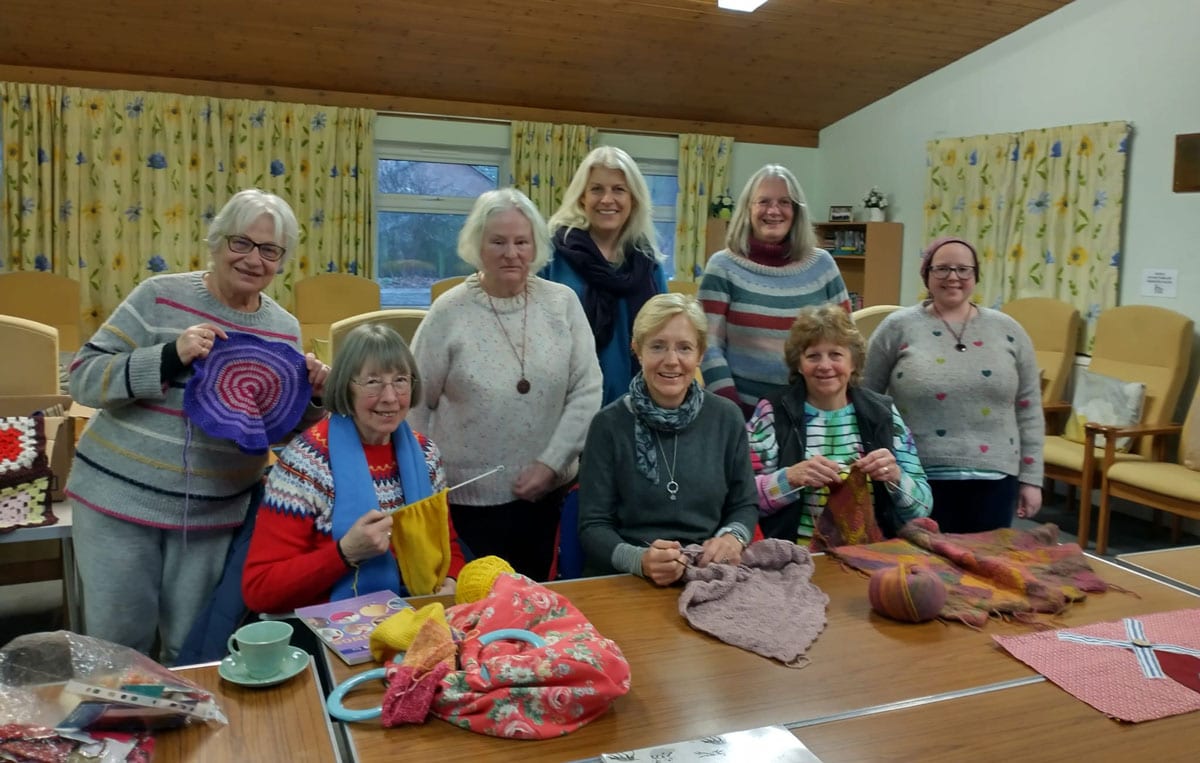
Those who create together, stay together. Technically, not quite how the saying goes but feels particularly relevant for the talented group of ‘material girls’ I had the pleasure of spending an afternoon with recently. Be it embroidery, knitting, crochet, quilting or, even, spinning – these ladies are sure to have seen it, done it and then made the t-shirt!
Brainchild of crafting duo Elaine Farrell and Jane Barrett, this independent and welcoming group provides a space to meet, chat and share ideas about crafting with fibre. Their first meet-ups took place back in 2020, but Covid lockdowns and the impersonal nature of crafting over Zoom ultimately proved too restrictive and they only managed two sessions before things were put on hold.
No set of challenges though, however difficult, was going to break this group’s spirit and in the autumn of 2022 Jane was persuaded to pick up those knitting needles and get things moving once again. For a group with no funding, this was not going to be an easy task, and Jane remembers it well.
“Encouraged by some very enthusiastic driving forces, Sally Mattson and Gina Barber in particular, we set out on a mission to find a local venue suitable for a group with no money. Luckily for us Libby Bennett at Homefield Close Community Centre welcomed us with open arms. I gambled a tenner on securing the building for our first meeting, publicity went out and I was amazed to see 14 people show up! At the second meeting, we took the decision we were viable to continue and now, I’m happy to say, we are sustainable in terms of paying for the hall and refreshments.”
The group meets fortnightly and the only rule is that there are no rules. Elaine and Jane’s vision was that the meetings remain unstructured – an opportunity to sit and craft, read craft magazines and books, exchange tips and tricks or simply, in Jane’s own words, “have a good old natter!”.
A creative haven
On the day I visited, I arrived to find a dozen or so ladies sitting around several large tables; cups of tea, a packet of Rich Tea biscuits, fabric, knitting and magazines strewn all around them. The welcome I received was a warm one and, as a self-confessed crafting failure (my daughter will happily elaborate if you want details), their diverse range of skills left me awestruck. On a vintage sewing machine, working on some beautiful fabric, sat a young woman newly resident in our community from Afghanistan; creating intricate piles of delicate patchwork quilt pieces was Carol; and busily embroidering the most delightful windmill was Lizzy.
Lizzy and her windmill. Photo Amanda Borrill
Lizzy joined the group just before Christmas and, having been through many years of serious illness as a youngster, finds the sessions immensely therapeutic. Sharing what it means to her she told me: “I really enjoy making and sewing things and I especially like to make craft things. Each Christmas, I hold a sale for my neighbours with the money raised going to Young Lives vs. Cancer – a charity very special to me because they supported me when I was young.
“At the moment I am making some wall hangings to go in our kitchen”, she explains. “I have lost my hearing. It has got worse and worse over the years and is particularly bad now. The audiology people have suggested that we carpet the floor and put things on the walls to help with the echoing of sound around the room, so I’m making pictures of the four seasons as wall hangings”.
For Lizzy, once a keen and promising musician, the impact of losing her hearing has left her feeling apprehensive about social situations and this group has been a lifeline. “A friend knew that I like to craft” she told me “and she suggested I might like to join this group where there are lots of friendly people all doing different things they enjoy. Even though I can’t hear well, they are all very kind and understanding.
“Most of my friends have been able to move on, get jobs and lives of their own and I’m left behind. Joining this group means I can be part of things a bit more, doing what I enjoy. I really recommend this group to everyone”.
“Don’t be afraid to have a go..”
From novice to near expert, you will be sure of a warm welcome. Kathryn, who regularly accompanies Lizzy to the meetings, joined the Fibrecrafters simply to get a few tips on how to improve her crochet but her time spent with the group has brought much more. “I don’t spend much time on my crochet”, she revealed “but find it relaxing to have a little project on the go. I’ve not advanced much but it is a lovely group where I was surprised to meet several friends I have known for years, as well as chat to new ones!”
Studies have shown that the repetitive actions of activities like knitting, and the satisfaction involved in creating, makes crafting well-suited for self-care, lowering stress and promoting wellbeing and I asked Jane what advice she would give to those thinking about resurrecting a forgotten hobby or taking up a craft for the first time. “Oh wow, that’s a tough one!” she replied. “I really enjoy the technical challenges of knitting and spinning. So, to begin with, I found a couple of wonderfully creative and knowledgeable knitters on YouTube and learned heaps about technique from them. I also followed an online magazine called Fruity Knitting which introduced me to many wonderful knitting designers and makers”.
“Then, in 2019, I went to Shetland Wool Week“, she continued. “It was wonderful having a go at new, diverse, classes such as making thrummed mittens, a shawl pin and designing Fair Isle gloves! With all that under my belt, I felt more confident about my knitting and started to look forward to meeting and chatting with others”.
Moira’s intricate knitting.
A stitch above the rest
For those who wish to learn from the best, there are few places better equipped with creative skill than a HI Fibrecrafters get together. Moira, well known locally for her stunning quilting and embroidery is a great all rounder – always very happy to share her deep breadth of knowledge with others – and Joan who, I discovered, holds legendary status amongst friends and family for her prolific jumper production, will happily pass on a tip or two if needed.
Jane’s Fair-Isle vest in the making. Photo Jane’s own.
I asked Jane, herself modelling a colourful striped self-knit, to reveal something of her own skill set. Unsurprisingly her answers revealed some pretty impressive talents. “When I retired, one of my aims was to develop my knitting skills beyond the basic. And I think I’ve done that”, she laughed. “I make hats, mittens, gloves, cowls, shawls and of course socks… and sell some of my products at craft fairs. I also make bespoke items and my sister-in-law keeps me busy with those. Most recently I’ve been knitting her a Fair-Isle vest with Shetland wool… that’ll keep her cosy!”
And, as if that’s not enough, there’s more: “Elaine kindled in me a passion for spinning and I have recently completed the foundation course in spinning awarded by the Association of Guilds of Weavers, Spinners and Dyers. I’m now registered for their Certificate of Achievement which will take my spinning to a whole new level with an exhibition of my portfolio as an endpoint. That’s very exciting.”
Top of the box
Christmas wreath in Somerset Road, Created by Gina Barber. Photo Bernie Kedge.
The group is also very open to collaborations with other local creative projects and has regularly helped out HI Ducks – another of the village’s talented creative groups. HI Ducks is the team behind many of the cheery post box toppers we have seen over recent years, after Alison Turnbull came up with the idea to add a bit of whimsy to the village. Since then, they have treated the community to creations that have included the Wind in the Willows, Babar’s picnic, the Queen’s Jubilee with Brian Maysheep on the castle battlements, elves collecting and delivering the Christmas post, Morris Men, dancing teddy bears etc.
Snowman – Xmas 22. Created by Sally Mattson. Photo Bernie Kedge.
Many crafts are evident in the displays – and that’s where the HI Fibrecrafters step in: knitting and crochet of course, but others, too – needle felting (remember the Queen’s corgi last year?), sewing (those topper covers are made too), free form embroidery (the banners), woodwork (the topper bases, the trees and the soldier), and artwork (that gorgeous painting of a stag on the Christmas topper).
Sally is one of those involved in putting together many of the scenes. “I really enjoy being part of HI Ducks”, she tells me. “I’ve mainly been involved in putting together toppers using components other people have made, which can include re-using pieces from previous toppers. Nothing gets thrown away” she explains. “Our knitters/crocheters are often very modest about their contributions and it is lovely to be able to show them off in a way that brings pleasure to a lot of people.”
Some of the hand crafted poppies displayed on Baptist Church post box. Photo Mike Barrett
It’s not all about quirky toppers though. Last autumn HI Fibrecrafters were also involved in creating a bunch of beautiful Remembrance Day poppies. Gina told me: “Approximately 80 poppies from a variety of designs and patterns were knitted or crocheted. These included purple poppies for the contributions made by animals, mainly horses in WW1 and dogs in recent wars, including the famous little Jack Russell in Ukraine. The white ones were for the hope of peace. Fellow crafter Marguerita and I sewed them all on.”
This is clearly a rewarding activity: “The crazy ideas, making the little creatures and the other bits and pieces, and putting it all together – the whole process is great fun”, Jane tells me with a big smile. “Villagers come up to us in the street to tell us how much they enjoy the displays. And the enjoyment is evident, when you see a crowd of people around the toppers and children being lifted up to see the displays and folks walking round the village to spot the displays.”
Getting technical
But, alongside all this crafting, we shouldn’t overlook the technical elements of these often very complex displays. The most recent of these have provided passers by with captivating lights and, even, music. Recalling how her engineer husband, Mike, first became involved Jane told me: “Mike got dragged into all the making because we needed a topper for the unusual Histon Post Office box. It’s an odd, curved shape and we needed a straight surface. So he made a wooden platform. Then someone suggested animation and music and he really got into it! We’ve had a jumping duck, a swing, a roundabout, a waving Queen, a windmill that turns and a church whose doors open and close. He even went and took photos of the Impington windmill so he could get the shape and dimensions right.”
So, there you have it – there’s plenty of scope for everyone to get involved in the fun and, if you are keen to share your skills, do get in touch with them. And lastly, any secrets to reveal on future yarn bombing projects? Sadly Jane was keeping the lid on that particular topic very tightly closed for now saying “watch this space… there is a big national event on the horizon and HI Ducks will swim into action soon”.
Sharing and caring
It would appear that the HI Fibrecrafters’ reputation for making and doing is beginning to spread. They were recently gifted a box of fabric – donated by the daughter of a lady who loved sewing because she wanted it to be widely distributed and enjoyed by many. “There were some very nice fabrics among them”, Jane revealed, “and lots of people in the group had some. The Afghan lady who came for the first time last week loves sewing but didn’t have any material, so she was delighted to choose some samples and started on a pair of pyjamas immediately. There’s still some left, so if anyone would like to take a look, please do let me know.”
Tunisian Crochet Hooks
Box of delights
Also, more unusually, Sally has recently acquired a set of Tunisian crochet hooks and is very keen to find someone out there who knows how to use them! If that’s you, please do get in touch!
That sharing and caring attitude is what the group is all about and Jane summed it up perfectly. “Crafters are friendly folk and we have a common passion, so conversation is easy. Simply put, if you fancy taking up a craft don’t be afraid to have a go!
“And if you need a push start, I’d be very happy to chat more about crafting to you.”
HI Fibrecrafters meet fortnightly. More details about the group and upcoming meetings can be found on their Facebook page or by emailing Jane on hifibrecrafters@gmail.com
Flory Ringer, manager of Histon’s Salvation Army Care & Share shop, talks to Bridget Davidson about what goes on behind the scenes at our local charity outlet, and how its volunteers go above and beyond to keep our castoffs out of landfill.
The winter months see everyone have a good post-Christmas clear out and the Salvation Army Care & Share shop is on the receiving end of much of that activity. I have to slide my way through the narrow spaces between rails stuffed with unwanted garments and shelves stacked with bric-a-brac to meet shop manager Flory. Now 62 and living in Impington, Flory has managed the shop for 15 years, starting in 2007 when the previous manager left. Before that she was a volunteer there.
Photo: Bridget Davidson
Her dedication is legendary. “Sometimes I work longer than the time I’m supposed to,” she says, and this can include volunteering on her days off, sometimes at short notice, to fill staffing gaps. I also met Ellen Sealey, former Relief Manager of the store, who came back to volunteer after she left. There must be something special about working there.
Flory says it’s all about communicating with people from all walks of life. “This is not just a shop, this is a meeting group,” she enthuses. “You can tell your story, you can socialise, you can cry, you can laugh, and there’s always somebody to listen. People come in to shop and chat.”
Seeing others find that special bargain and saving items from landfill is up there too. “People find this place like a miracle shop,” she says, with a smile. “They find the thing they’ve been looking for.” It’s got to feel good to be part of that.
I show Ellen the jacket I’m wearing and a high-end handbag, both found in the shop. “People are so generous here,” she says. I’m telling her what good quality the leather of the bag is when Celia, another dedicated volunteer, comes in and overhears our conversation.
“We’re the Harrods of Histon,” she says. It’s a name she came up with, which is apparently used frequently to describe the shop by regular buyers. With the levels of dedication and customer service on offer there, it’s impossible to disagree.
An ordinary day
Flory Ringer, Manager of Histon Care & Share. Photo: Jo Tyler
With donations having flooded in since Christmas, the back room behind the shop floor is as tight for space as the shop. Floor to ceiling storage is stuffed with items and there are full plastic bags of all sizes all over the floor. I ask if I can sit down to take notes while we talk. Flory clears a pile of things off one of only two chairs I can see in the room and shoves some other stuff aside to make space on a flat surface for my notepad. I imagine it’s a table but I can’t tell, as the rest of it is covered in donations. The only other chair is occupied by Ellen, who is steadily tagging clothes with her little gun, so Flory stands.
The shop receives around 20 bags of donated goods every day. It’s open six days a week, excluding Sundays, making approximately 120 bags per week to be processed. “On an ordinary day we receive the goods and have one volunteer sorting and one volunteer pricing and hanging,” she says. “Everything has to be sorted, everything is inspected. For clothes, to see if it’s dirty or torn or marked. Nice things go into a pile [for pricing]. We do this every day.”
The sorting
The not-nice things are kept back. Clothes and textiles are re-bagged and sold for £3.50 per bag to a textile recycling company. The shop also has dealers who buy items ranging from books, CDs, DVDs and computer games to jewellery, watches, cameras, toys, coins and metals.
Even broken items can be sold on. Some donations go to auction or sell online via social media. Not much is left behind after all these efforts. Everything that is goes into large bins out the back, either for recycling or landfill. Flory says that about 3-5 bags in every 20 end up with the textile company. For bric-a-brac she estimates about 3-5% of donations are unfit for resale.
I press Flory for more detail about the work they do, thinking there must be other daily tasks as well, but no. She tells me they sort all day long. This is their day.
Items that make it onto the shop floor receive the greatest attention. “People bring in dirty stuff and staff clean it.” Ellen says. Anything grimy but still saleable is buffed up by someone in the backroom before it’s put out for sale. Although there’s no space for a washing machine, all clothes are given a once-over with a steam cleaner. Even bric-a-brac items are cleaned and homewares too. Ellen mentions dirty but serviceable saucepans as an example. They are washed by hand, by volunteers. I’m slightly incredulous, given the amount of stuff they already have to get through every day. Registering my dismay, Ellen continues, “We don’t want to do it.” The frustration is evident in her voice. Yet they do, such is their dedication.
Frustrations
Flory is still standing, so I ask her: ‘Would more space help?’ Rumours have been floating round that the shop may move into the former Barclays space on the High Street. Flory insists this is not on the cards. Even if it was, she’s not for it.
“I don’t want a bigger place, as it would still be the same problems.” Bigger space, bigger problems. It’s hard not to see her point. Yet the amount the shop does take is still not enough for some people.
Even dragons are for sale in Care & Share. Photo: Bridget Davidson
The staff have to deal with stuff left at the door outside of opening hours (despite signs asking people not to). Then there are donors who won’t take no for an answer when the shop is already overflowing.
“These customers can feel angry – sometimes very angry,” says Flory, “but it’s better to deal with this than be closed down by health and safety. We don’t want to refuse but we have no space.”
The sense of entitlement from some donors is one of the biggest frustrations the team has to deal with. I ask how it feels when people dump and run.
“[It’s] Annoying! Some people leave things they know we don’t take, and use us as a dumping ground.” As soon as the back door is closed, even during the day, bags will appear. “Some people want us to chuck it for them. They think that because they are giving it to us it’s OK to do that.”
If it rains, these no doubt well-meant donations can end up getting wet, rendering them unsellable. Electrical goods are the worst. The shop can’t accept them but that doesn’t stop them being left for Care & Share to deal with.
“People know we don’t take electricals but then they leave them inside a bag,” she continues. Tucked in the depths of a bin liner volunteers can’t see these items until it’s too late. Flory then has to make sure they are disposed of correctly. So they can be sold on, if possible, she takes time out to drop them off at other charities, such as EACH on Histon Road, Cambridge or, for certain electrical goods, Emmaus, near Landbeach. Any batteries found in the offending electricals are stored up in a bag Flory points out to me, hanging on a hook just beside my head. When it’s full someone takes it to Tesco across the road to their recycling bin, as Care & Share doesn’t actively collect them.
Community support
Given the many challenges and frustrations facing this valuable community resource, what can residents who donate at Care & Share do – other than volunteering – to make life just that bit easier for the amazing team who keep the doors open?
Captain Rob Symons, Commanding Officer and Histon Corps and Divisional Candidates Officer, says: “The golden rule is check first and ask or call, email or message us ahead.
“We are very conscious that people want their items to be used by and for The Salvation Army. However, this is where they can help us by checking what we can and can’t accept first.”
Local resident Don Kelly walked and talked with Sheryl Bailey as they dodged the downpours and set off with Billy, the renowned King Bill hound, along the historic Gun’s Lane footpath.
“There are some great walks around Histon & Impington,” I was told, “so why don’t you find yourself a walking pal and follow the trails? And please take a dog.”
Don and Billy get to know each other. Photo: Sheryl Bailey
“Great idea,” I said, and envisaged writing an article that would be a cross between Clare Balding’s Ramblings and the Louis Theroux interviews – only without the famous people or exotic trips to distant places. Perhaps the dog would give my article ‘star’ appeal.
I chose my first victim carefully. Even if you haven’t met Don Kelly, you’ve probably come across his name. Chairman of the Histon Beer Festival Committee, designated village minibus driver, trustee of HI Friends, and expert canasta teacher, he was also front and centre of the awesome village response to the covid lockdowns.
Known as ‘The Don’ to his Beer Festival pals, this chap is the real deal. An all-round solid good egg if ever there was one. But don’t even think of taking him on at a pub quiz. He’s been a contestant on three televised quizzes – including Eggheads – and won some great prizes, with specialist subjects being real ale (shock), Manchester United (sad), and African mammals (solid).
Covid got him back into walking and enjoying nature and, as one of his ambitions is “to die fit and relatively healthy”, I deduced he definitely had the stamina for the walk. The only problem was, he doesn’t have a dog. Easily fixed. Step forward King Bill landlady Susie and her partner Mark, who generously loaned us their gorgeous beagle Billy ‘Bryan’ for the expedition.
Getting under way
I say expedition, but that’s a bit of an exaggeration, even though Gun’s Lane used to be the main road from Cambridge to Ely and William the Conqueror and his army is said to have used it when they chased Hereward the Wake into the Fens.
A muddy start. Photo: Sheryl Bailey
The route takes in some of the countryside on the northern side of Histon where it borders Westwick, and forms a 3.5 mile loop through wide open fields, herds of sheep, ancient hedgerows and a flowing brook (especially in the rain).
And rain it did. So much so that our planned walk began with a cheese and ham toastie on the sofa at Don’s house while we waited for the pelting downpour to pass before setting foot outdoors. Two days later we finally got ourselves suited and weatherproof booted before setting off to Gun’s Lane. The prospect of knee-deep mud for the first 200m of the lane meant another change of plan, involving a short and very pleasant diversion across Croft Close set-aside.
Don rescues his hat… Photo: Sheryl Bailey
For someone who doesn’t own a dog, Don proved surprisingly dexterous with a dog lead. “The benefits of walking for your mental health and wellbeing – especially with a dog – are huge,” he said, clearly enjoying the opportunity to give Billy an unexpected outing. “Minnie, our cat just isn’t interested,” he added wistfully.
To be fair, it wasn’t just a walk in the park. There was a moment when he had to wrestle what’s left of a tennis ball from Billy’s jaws without causing an accident on the Oakington to Westwick Road. Then there was the incident with the poo bag splitting and my unflappable friend’s hat catching on a bramble. I (un)helpfully took photos instead of supervising Billy… always thinking of the article.
The Don
It was time to find out more about Don and what drives him to take the lead in so many community endeavours.
He and his wife Lesley moved to Histon in 2008. His house is in a fantastic location with enviable vistas of Abbeyfields and woodland views. He takes great pleasure from his beautiful garden, “although Lesley does all the work!” he admitted. He has become an avid fan of Twitcher bird apps. “Identifying birds from just their song is a great joy,” he explained.
A structural engineer by trade – now retired – he is one of the world’s great positive thinkers. “I always strive to be happy by being positive about things. I have made fortunate choices with work which has given me certain freedoms at this point in life.Regularly seeing our two daughters, grandchildren and both our mums, who all live nearby, gives me great pleasure.”
The route skirts fields and offers great views and beautiful skies.
He loves to travel with Lesley, and fly-drive holidays and wildlife spotting are their thing.
“Since living and working in Africa, I developed a passion for the continent and safaris are our favourite holidays,” he said. “We’re hoping to go to Zimbabwe next.”
Village life
As for Don’s involvement in the village: “I like being busy and always crave a full diary, but preferably not being overly stressed” he said. “I want to do things that give me personal pleasure, but also the pleasure of giving something back to the community.” These are not empty words. Added to his already busy schedule in 2023 will be a commitment to the first ever HI Friends Wellbeing Festival, planned for late spring.
The early mornings aren’t for him. So being an owl rather than a lark, it’s perhaps not surprising that the Beer Festival is among his community activities. He was a bit of a late starter, having hardly visited a pub until he left home for university aged 18. But he’s made up for lost time since. “I’ve decided I could live without beer but wouldn’t want to” (Hurrah for this!). Getting the 23rd Histon Beer Festival organised and being even more successful than last year is on his list for 2023 (A second hurrah for that).
“I crave the social interaction in pubs. The whole purpose of going out for a drink is the social side and always think I’m missing out if not in the thick of the conversation somewhere,” he said. You might not believe it now, but Don was apparently, “a very shy and insular child”. He went to a private, single-sex school on a scholarship and declares himself to have been, “academic, studious, well behaved… and really boring!”
A post-walk nap for Billy
…and finally
As we approach the end of our walk, there’s just time to slip in two more personal questions to wrap up the interview.
What scares him? “The smell of chlorine still gives me the shivers,” he admits. “I didn’t learn to swim until I was 14. Every Wednesday at school they take you to the pool and throw you in until you learnt. It was a great method for causing lifelong trauma.”
And what would he like to see in 2023? “Manchester United to qualify for Champions League.” Oh dear… he may be a bona fide Egghead, but clearly there’s still a thing or two he needs to learn.
Around 10 years ago, a small group of Histon & Impington residents drew up a set of easy to follow instructions introducing seven circular walks that start and finish in the village. Over the next 12 months, Sheryl Bailey will be walking these routes accompanied by members of the community and their dogs, and HI HUB will be sharing their stories.
The words, ‘Neighbourhood Watch’ may call to mind the twitching curtains and nosey neighbours of yesteryear, but as Cedric Foster found out, coming together with your street can offer peace of mind and a lot more…
Did you know that there are currently just nine Neighbourhood Watch (NW) schemes covering streets in Histon and Impington? With a population of over 11,000 – that’s a small proportion of streets represented.
Residents of Winders Lane, as far as the junction with Clay Street, are the latest to get active on local security, by resurrecting a NW scheme that had been dormant for more than thirty years. New signs have appeared on local lampposts and neighbours keep each other up to date and share any concerns via a WhatsApp group.
Getting hands-on
Histon and Impington NW groups form part of a broader network across Cambridgeshire, each with its own volunteer area coordinator, with the aim of keeping their communities safer.
Activities the security-conscious residents take part in range from litter picking and local tidy-ups to connecting with the local police to learn about campaigns and initiatives that may affect them.
John Fuller, the South Cambridgeshire area coordinator, explained to me: “People join Neighbourhood Watch for many different reasons. Many residents wish to improve safety around their home and street, while others simply want to feel part of an active community and meet new people.”
Having an active NW can also play a part in finding and apprehending criminals through reporting information and sightings to the police .
Getting covered
Roads in Histon and Impington which are registered to be part of NW schemes include Impington Lane; Pages Close; Parlour Close; Aingers Road; Burkett Way; Park Lane; School Hill; Windmill Lane & Bell Hill; Muncey Walk (bordering with Narrow Lane) and New School Road.
Getting involved
John believes the benefits of joining up are clear: “As well as reducing and preventing local crime and anti-social behaviour, having a NW scheme can also reduce fear of crime, which in turn helps improve residents’ quality of life.”
Setting up a new NW in your street could also capitalise on the feeling of community spirit and cohesion many people experienced at the height of the Covid pandemic, when neighbours came together in a way that they perhaps hadn’t previously.
Many streets started WhatsApp groups at that time in order to look out for elderly or sick neighbours or just to help with shopping or errands, so there are already networks established, just waiting to be turned into official schemes.
If you would like more information about setting up a Neighbourhood Watch group in your road, or wish to resurrect an old scheme that has lapsed, visit www.ourwatch.org.uk
A pair of running shoes and a few fellow runners could be all you need to find the motivation to get out and get running. Eddy Moore found out what the village has on offer to help you take those first steps.
New Year’s Resolutions traditionally include the determination to get fitter and running could be an appealing option. A pair of running shoes, comfortable kit and you can just open your door and set off. The health benefits of regular aerobic exercise are well-known, and you will build healthy joints and strong bones, strengthen your heart and accelerate your metabolism. There are also advantages for your mental health and well-being. However, starting to run can be a daunting prospect for those who haven’t run for years, or a lonely prospect for those who would enjoy some company as they pound the pavements. Fortunately, in Histon & Impington, finding running companions isn’t a problem – whatever your age or fitness – so that excuse simply won’t hold water!
Spoilt for choice
The Hobblers at Histon Manor earlier this year. Photo: Jo Roach / Katherine Mann
There are two local running groups based in the village, both of which are friendly and fun. HI Runners is a mixed running club which meets at Histon Rec on Wednesday evenings. The club is there for runners of all abilities, supports their members’ personal goals, and helps them progress to whatever level they wish to achieve. The Club is affiliated with UK Athletics, rapidly growing and always welcoming to new adult members.
But if that still feels a bit daunting, then maybe Histon Hobblers – who celebrated their 20th anniversary this summer – might be for you. The group started in 2002 with the aim of: “let’s get off the couch and learn to run 5Km for the Cancer Research Race for Life”.
Over the last twenty years it has become a safe space for friendship as well as exercise, welcoming women of all ages and abilities. Their motto is “Hear us coming, join us running!” The Hobblers have completed marathons, half marathons and many local 10K races in their pursuit to raise money for various charities. Groups of members go out at times which suit them. Just contact Jan Watt for further details, at running@histonhobblers.co.uk.
Do it alone
Of course, running buddies are not for everyone and, if that’s you, then this still isn’t a good enough excuse for not getting started! Anyone looking for a free and easy way to get fitter and healthier could use the Couch to 5K app to give them that boost for getting started and, most importantly, keeping going. Absolute beginners start with a mix of jogging and walking three times a week with a rest day between each run, and the app will keep them on track and guide them through the whole process. Over the course of 9 weeks you gradually build up longer periods of running with the aim of being ready to run 5K.
Once you’ve made it to 5K you could aim for a race taking place in Impington on Monday 1 May. A little more practice and the Flaming June 10K and half marathon on 11 June could be your next target, followed up by the Bonfire Burn 10K on 5 November. All of these events take place here in the village, giving new runners something to aim for, and experienced runners the chance to smash their ‘personal best’. Details of all these events will be published in HI HUB and on the HI Friends website.
To keep you going between these village events, there are also the popular park runs to give you a weekly target for keeping going. Although not here in the village, there are three of these free fun and friendly weekly runs nearby, with adults running 5K at 9am on Saturday mornings in Coldham’s Common, Storey’s Field or Fulbourn Hospital.
Not just for adults
It’s not just adults who can benefit from running, and helping children to develop a love for exercise and the outdoors is a gift they will value for the rest of their lives. Every Sunday morning there is a 2K Park Run for children and young people, and the nearest to Histon and Impington takes place at Milton Country Park. These friendly, volunteer-run, events are free to take part in but a one off pre-registration via the parkrun website is essential before your first event. If your family is happy to go a little further afield there are also Junior Park Runs at Wimpole Hall and in Cambourne.
For more information on local running groups look at www.cambridge.gov.uk/running If you are taking up running this month HIHUB would love to get your progress reports. admin@hihub.info
Cookie Consent
We use cookies to improve your experience on our site. By using our site, you consent to cookies.